
For Muslim parents in the UK and across Europe, giving children a strong Quranic education can sometimes be challenging. Between school, homework, family commitments, sports and other activities, finding regular time for Quran lessons is not always easy.
This is why many parents consider online Quran classes for children as an alternative to traditional madrasa or mosque-based Quran lessons.
But is learning the Quran online actually better than attending a traditional madrasa?

The answer is not simply one or the other. Both approaches can work well, and the right choice depends on your child’s age, learning style, schedule, access to qualified teachers and your family’s priorities.
In this guide, we compare online Quran classes vs. traditional madrasa education and explain what parents should consider before choosing a Quran learning programme for their children.
What Is the Difference Between Online Quran Classes and a Traditional Madrasa?
A traditional madrasa usually provides face-to-face Islamic education in a mosque, madrasa building or community centre. Children travel to the location at a fixed time and learn alongside other students.
An online Quran academy, on the other hand, provides Quran lessons remotely using a computer, tablet or other suitable device. Depending on the academy, children may have one-to-one or small-group lessons with a qualified Quran teacher.
Both approaches can teach important subjects such as:
- Quran reading
- Noorani Qaida
- Tajweed
- Makharij and pronunciation
- Quran memorisation (Hifz)
- Basic Islamic studies
- Daily duas and Islamic manners
The major difference is how, where and when the learning takes place.
Advantages of Traditional Madrasa Quran Classes
Traditional madrasa education has been part of Muslim communities for generations, and it offers several genuine advantages.
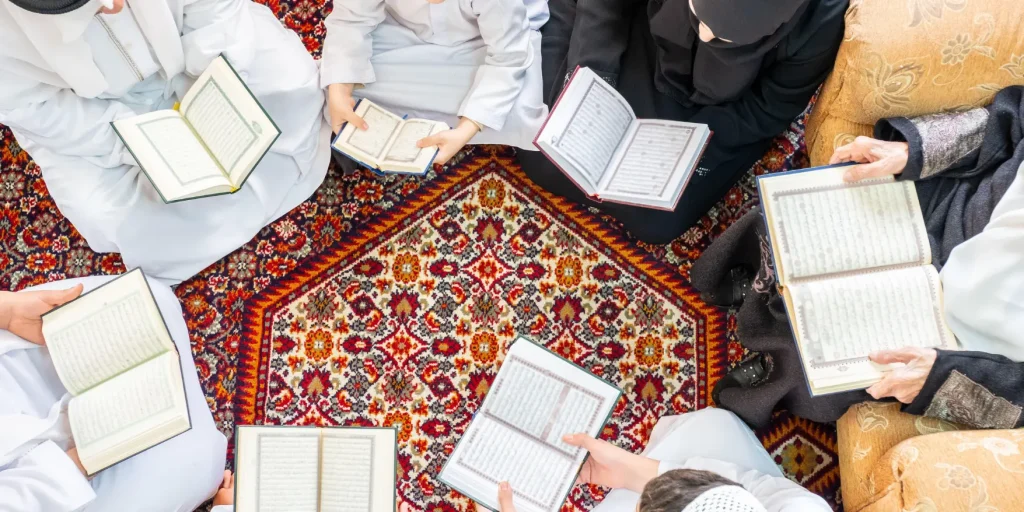
Face-to-Face Interaction
Children can communicate with their teacher and classmates in person. This can help some children feel connected to their learning environment and community.
For younger children who enjoy learning around their peers, the social aspect can be particularly valuable.
A Structured Learning Environment
A madrasa normally has a fixed timetable. Children attend at a particular time each week, which can encourage consistency and routine.
For families who live close to a good mosque or madrasa, this structure may be a major benefit.
Community Connection
Attending a local madrasa can help children develop relationships with other Muslim children in their community. It can also provide opportunities to participate in activities connected with the local mosque or Islamic centre.
Less Screen Time
One obvious advantage is that children do not need to spend additional time in front of a screen.
For parents already concerned about how much time their children spend using phones, tablets and computers, face-to-face Quran lessons may feel more natural.
However, traditional learning also has limitations, particularly for families who have busy schedules or do not live near a suitable Quran teacher.
Advantages of Online Quran Classes for Children
Online Quran learning has become increasingly popular among Muslim families living in the UK, Europe, North America and other countries where access to qualified Quran teachers may be limited.
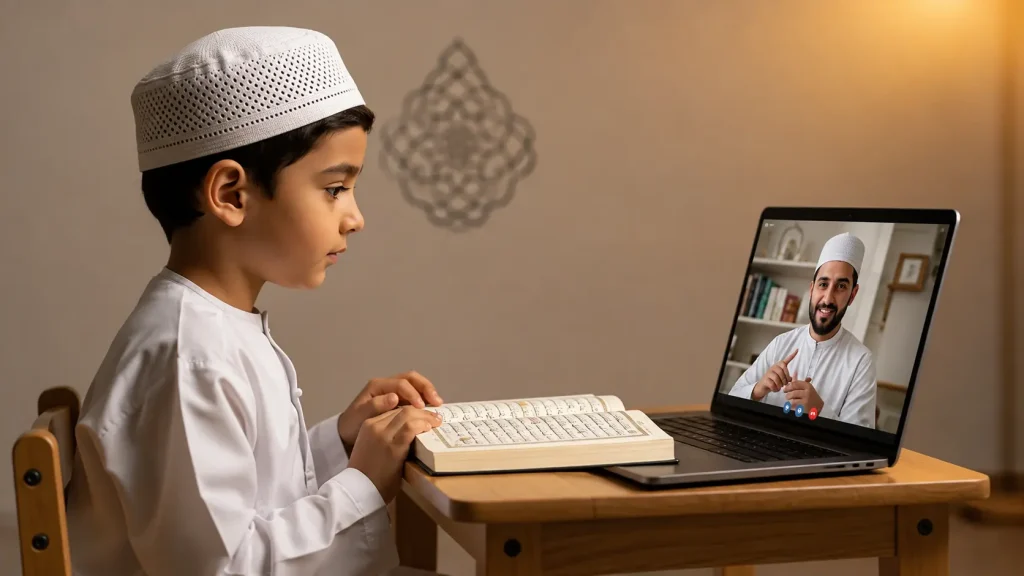
Flexible Quran Learning for Busy Families
One of the biggest advantages is flexibility.
Children can attend Quran lessons from home without travelling to a mosque or madrasa. This can be particularly useful for families managing school runs, homework, extracurricular activities and work commitments.
For example, a child could attend a Quran lesson after completing their school homework rather than spending additional time travelling to a madrasa.
One-to-One Attention
Many online Quran academies offer individual lessons, allowing the teacher to focus entirely on one child’s reading and pronunciation.
This can be particularly useful when learning Tajweed and Quran pronunciation, where small mistakes may need to be identified and corrected repeatedly.
Instead of waiting for their turn in a larger classroom, a child can receive continuous feedback throughout the lesson.
Access to Teachers Beyond Your Local Area
Parents are not limited to teachers within travelling distance.
An online Quran academy can connect families with teachers who have experience teaching children from different countries and backgrounds.
This can be especially helpful for Muslim families in areas where there may not be a suitable mosque or madrasa nearby.
Learning From the Comfort of Home
For many children, home can be a comfortable and familiar learning environment.
Parents can also remain nearby during younger children’s lessons and take a more active interest in their progress.
Digital Learning Resources
Online Quran lessons can also make use of digital learning materials, screen sharing, audio examples and other educational resources.
However, technology itself does not automatically make education better. The Education Endowment Foundation (EEF) notes that teaching quality is more important than the method of delivery, while technology is most useful when it supports effective teaching and practice.
This is an important point for parents: choosing an online Quran academy should be about the teacher and teaching system, not simply the fact that lessons happen online.
Online Quran Classes vs. Madrasa: Which Is More Effective?
There is no universal winner.
A good teacher, appropriate curriculum and consistent practice matter more than whether the lesson takes place online or in person.
As per Gem 2023 Research into digital education supports this balanced view. UNESCO’s Global Education Monitoring work notes that digital technology can improve opportunities for practice, personalise instruction and increase interaction, but positive outcomes cannot always be attributed to technology itself.
In other words, an excellent online Quran teacher can provide a highly effective learning experience, while a well-organised local madrasa can also be an excellent choice.
The question parents should ask is:
Which learning environment will help my child learn consistently and correctly?
Which Option Is Better for Quran Reading and Tajweed?
For children learning Quran reading from the beginning, both options can work.
A child may begin with Noorani Qaida, learn Arabic letters and sounds, and gradually progress towards reading the Quran fluently.
Tajweed requires particular attention because correct pronunciation is an important part of Quran recitation. Whichever learning method you choose, the teacher should be able to listen carefully, identify pronunciation problems and provide constructive correction.
For parents considering online learning, individual lessons can be particularly convenient because the teacher can focus directly on the child’s recitation.
You can explore an organised course to learn Quran online to see how structured online Quran learning can work for children and beginners.
What About Quran Memorisation?
The same principle applies to Hifz.
Quran memorisation requires:
- Regular revision
- Consistency
- Accurate recitation
- Teacher feedback
- A manageable learning schedule
- Parental encouragement
A traditional madrasa may provide a strong routine, while online lessons can offer greater flexibility and individual attention.
For a child attending full-time school in the UK or Europe, flexibility can be particularly important. A rigid schedule may become difficult when school hours, exams and family commitments change.
Learn more about our Quran Hifz – Quran Memorization Course
What Should Parents Look for in an Online Quran Academy?
Choosing an online Quran teacher should involve more than comparing prices.
Parents should consider:
Qualified and Experienced Teachers
Ask about the teacher’s Quranic education, teaching experience and ability to work with children.
For Tajweed or Hifz, parents may also want to understand the teacher’s specific qualifications and experience in that area.
Child-Friendly Teaching
Children learn differently from adults. A good teacher should be patient, encouraging and capable of keeping young learners engaged without making lessons unnecessarily stressful.
Safeguarding and Online Safety
This is especially important when choosing an online Quran teacher for children.
The UK Department for Education’s guidance for parents specifically covers supplementary schools, religious education, private tuition and online safety. It recommends that parents ask questions, check providers’ policies and satisfy themselves that appropriate arrangements are in place.
Parents should therefore ask about safeguarding procedures, teacher vetting, communication policies and how one-to-one online lessons are supervised.
A Clear Learning Plan
The academy should be able to explain what your child will learn and how progress will be assessed.
A good programme might move progressively from:
Noorani Qaida → Quran Reading → Tajweed → Fluency → Hifz or further Islamic studies
Transparent Pricing
Cost is naturally another consideration for families.
Parents should look beyond the cheapest advertised lesson and consider class duration, frequency, teacher quality and what is included.
You can view Quran classes cost and fee plan information to understand the type of pricing structure available.
Can Online Quran Classes Replace a Madrasa?
For some families, yes. For others, they work better as a complement to local Islamic education.
An online Quran academy does not have to compete with the mosque or madrasa. Parents can combine different forms of Islamic learning depending on their child’s needs.
For example, a child might study Quran reading and Tajweed online while also participating in activities at their local mosque or Islamic centre.
This blended approach can provide both individual Quran instruction and community involvement.
How to Choose the Right Quran Learning Option for Your Child
Before deciding between online Quran classes and a traditional madrasa, consider these questions:
- How far is the nearest suitable madrasa?
- Does its timetable fit around school?
- Does my child learn better individually or in a group?
- Does my child need additional help with Tajweed or pronunciation?
- Can we maintain a consistent weekly routine?
- Are the teachers appropriately qualified and experienced?
- What safeguarding arrangements are in place?
- How is my child’s progress monitored?
- What are the total costs, including travel if applicable?
- Which environment will help my child enjoy learning the Quran?
The best choice is ultimately the one that allows your child to learn consistently, recite correctly and develop a positive relationship with the Quran.
Why Online Quran Learning Can Work Well for Muslim Families in the UK and Europe
For families living in the UK and Europe, online Quran education can solve a practical problem: finding reliable Quran tuition that fits around modern family life.
Children already have busy school schedules. Parents may work long hours, commute or manage multiple children. Travelling to a madrasa several times a week can therefore become difficult.
Online lessons remove much of that logistical pressure.
At the same time, parents should not choose an academy simply because it is convenient. The quality of teaching, teacher experience, safeguarding, curriculum and consistency should remain the priorities.
At Al-Farooq Quran Campus, families can explore structured online Quran learning designed to make Quran education accessible from home.
Final Verdict: Online Quran Classes or Traditional Madrasa?
So, online Quran classes vs. traditional madrasa — which is better for children?
There is no single answer for every family.
A traditional madrasa can provide face-to-face interaction, community connections and a structured environment. Online Quran classes can offer flexibility, individual attention and access to teachers regardless of geographical location.
For many Muslim families in the UK and Europe, online Quran learning can be a practical and effective solution, particularly when local options do not fit around school and family schedules.
What matters most is not whether the lesson happens through a screen or inside a classroom. What matters is the quality of the teacher, the consistency of learning, the suitability of the programme and the child’s ability to learn in a safe and supportive environment.
The goal should always be the same: helping children read the Quran correctly, understand its importance and develop a lasting connection with their faith.
Frequently Asked Questions About Online Quran Classes and Madrasa
Are online Quran classes suitable for children?
Yes. Online Quran classes can be suitable for children when lessons are age-appropriate, structured and taught by an experienced teacher. Parents should also check the academy’s safeguarding and online teaching arrangements.
Is online Quran learning better than going to a madrasa?
Neither option is automatically better. Online Quran learning can offer flexibility and individual attention, while traditional madrasas can provide face-to-face interaction and community involvement. The right choice depends on the child’s needs and the quality of the available programme.
Can children learn Tajweed online?
Yes. Tajweed can be taught online through live lessons where the teacher listens to the child’s recitation and provides immediate correction. Consistent practice between lessons is also important.
What age should children start learning the Quran?
There is no single ideal age for every child. Many children begin learning Arabic letters and Noorani Qaida at a young age, but the pace and teaching method should be appropriate for the child’s development and attention span.
How long should an online Quran class be for a child?
The appropriate lesson length depends on the child’s age, concentration and learning level. Younger children may benefit from shorter, focused lessons, while older children may be able to manage longer sessions.
How much do online Quran classes cost?
Prices vary depending on the number and length of lessons, teacher experience, course type and academy. Parents should compare the overall value and teaching quality rather than choosing solely on price. You can see the Al-Farooq Quran Campus fee plan for current course pricing.
How can parents make online Quran lessons more effective?
Parents can help by providing a quiet learning space, ensuring the child attends lessons consistently, encouraging daily Quran practice and communicating with the teacher about progress.
Is an online Quran academy suitable for families in the UK and Europe?
Yes. Online learning can be particularly convenient for families who have busy school schedules or limited access to suitable local Quran teachers. It also allows children to study from home without travelling to a madrasa.
A strong Quran education does not depend solely on where a child learns. It depends on how well they are taught, how consistently they practise and how positively they experience their journey with the Quran.
